 (Vanderbilt University Blog, 2013)
Sustainability
is a very in-depth idea of keeping everything in order. Through doing
particular things within each group, you keep the world sustainable.
I've found that out of
the three diagrams of sustainability, I agree with all, but mainly the
3-overlapping circles. Economy, Society, and Environment work together. They
need each other and the visual circle in the middle of all three is the
'perfect' sustainable world.
I think that a
sustainable world is close to impossible. I do not think that we - humans, are
able to exist peacefully, have a perfect society, and not harm our environment.
Why? Because we do not care enough to keep our world safe. We as humans get
upset when we have law-breakers. When we have unethical people making the world disgusting. We forget that we
- teachers, families, politicians, etc., that make those people. We enforce
punishment, but we don't enforce that the websites, or movies and such be less
accessible.
No, I don’t have a thousand different techniques or
theories to fix these problems. I personally think that our world is going to
get worse. That we are not going to be sustainable. And why do I propose such a
preposterous notion?
Because this world is going to end. Many people will
say it is a holocaust. I say it is the rapture, followed by the tribulation. It’s
not a soft, happy word. Tribulation. A seven-year reign in which the Antichrist
sucks as many people into his trap as he can. This world is going to end – and it
is our responsibility, as Christians, as the young people of this world, to
bring as many people to Christ as we can. To be aware that this world is going
to get worse and accept responsibility, because when we become Christians, we
are obliged to take up our crosses – DAILY – and follow God.
“Be faithful until death, and I will give you the
crown of Life.” Revelation 2:10

3- Nested Dependencies
3-Overlapping-Circles"The overlapping-circles model of sustainability acknowledges the intersection of economic, environmental, and social factors. Depending on our mindset, we re-size the circles to show that one factor is more dominant than the other two. For example, some business leaders prefer to show the economy as the largest circle because it is the most important to their success and it makes their world go round. | 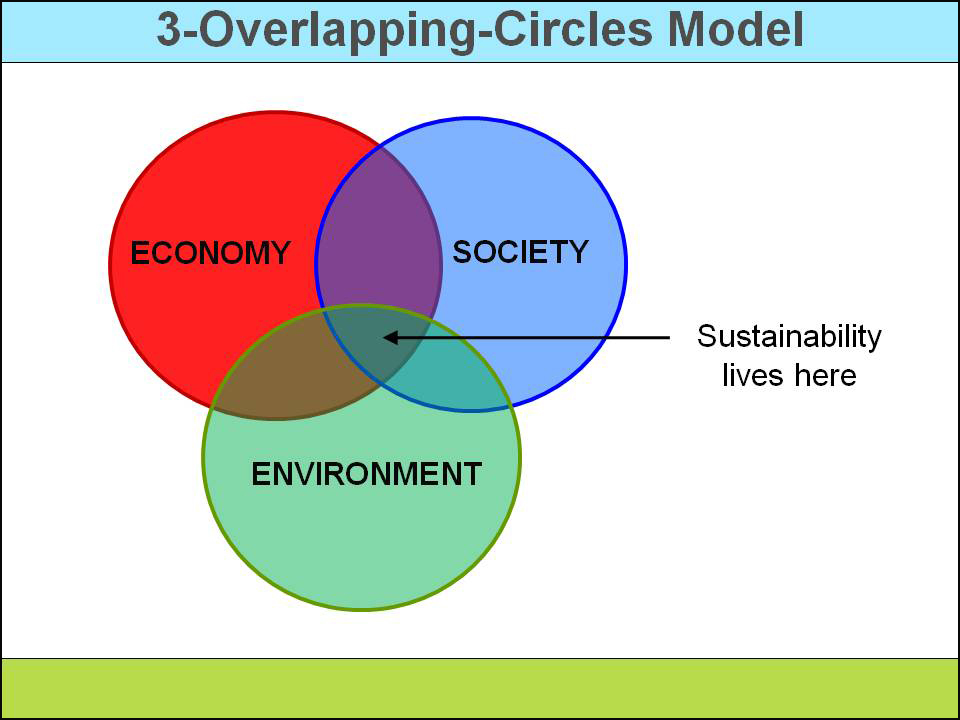 |
"They draw society as the second largest circle because that is where their customers and other important stakeholders live. The environment would then be the smallest because it is the most external to standard business metrics. Unfortunately, this model implies that the economy can exist independently of society and the environment—that the part of the red circle that does not overlap with the blue and green circles has an existence of its own." (Willard, 2013)

No comments:
Post a Comment