Tuesday, 23 April 2013

The Heritage of Aboriginals and Torres Strait Islanders


“The very ink with which all history is written is merely fluid prejudice.”
Mark Twain                                                                              (Heritage, Aboriginal, 2013)
 (Heritage, Aboriginal, 2013)                              
It is quite difficult to find the heritage of Aboriginals and Torres Strait Islanders, without being one!I have had quite a hard time. What I have found - my opinion, is that Aboriginals and Torres Strait Islanders are a special group, - yes. Aboriginals had settled the land of Australia before the white man came. They descended from one of Noah's sons, - Japheth, I believe. The darker skinned person migrated to a mass of land that would later be called 'Australia'. When the white man came, Aborigines had lived in this land for a long time. They knew the land, and they were a part of the land. And my argument is that they worshiped the land, and nature, and ignored God. When the white man came, they came looking to conquer the land. They wanted to be kings. And they did, through force. Through force...forgive my brain, but that means the Aborigines fought the white man. The white man came into the land with big expectations and with barbarian ideas. But, the Aborigines fought fiercely back at them. In this day and age, we have politicians and other people that think they must repay the Aborigines in this day and age for the wrongs white man did to them back in the 19th Century. Well, I think that idea is the weirdest notion ever! 

I teach Sunday School and enjoy it immensely. In my class I have three Aboriginal children. These children have a right to their heritage, they have a right to the land. But, I have a right to my heritage, no matter how gory ancestors were, or the fact that my ancestors came in chains, I have a right to my heritage. I do not have a right to force others to repay me a debt that happened to someone I had never met. And the little children I teach do not have a debt to repay white man, or to hold a grudge on behalf of the Aboriginal man. 
We all have dark parts to our heritage, but we should be proud that we live in a land that allows us to work together. I thank the Lord that He has given me a love for children. Because if we still lived in a world that segregated white man against Aboriginal, I would still teach those three little ones...and as many as I could!
 (Heritage, Aboriginal, 2013) 
                                                                                                                   

 (Heritage, Aboriginal, 2013)

European Discovery and Arrival

"The arrival of Lt James Cook in 1770 marked the beginning of the end for this ancient way of life. Cook’s voyage of exploration had sailed under instructions to take possession of the Southern Continent if it was uninhabited, or with the consent of the natives if it was occupied. Either way, it was to be taken. Upon his arrival, Lt Cook declared the land he called New South Wales to be the property of Britain’s King George III, and ignored the inconvenient fact that the land was already well populated. His failure to even attempt to gain the consent of the natives began the legal fiction that Australia was waste and unoccupied.
"Cook was followed soon enough by the arrival of the First Fleet, in January of 1788, under the command of Captain Arthur Phillip, whose mission was to establish a penal colony and take control of Terra Australia for settlement."  (Heritage, Aboriginal, 2013)
"We found the natives tolerably numerous as we advanced up the river, and even at the harbour’s mouth we had reason to conclude the country more populous than Mr Cook thought it. For on the Supply’s arrival in the [Botany] bay on the 18th of the month they assembled on the beach of the south shore to the number of not less than forty persons, shouting and making many uncouth signs and gestures. This appearance whetted curiosity to its utmost, but as prudence forbade a few people to venture wantonly among so great a number, and a party of only six men was observed on the north shore, the governor immediately proceeded to land on that side in order to take possession of this new territory and bring about an intercourse between its new and old masters."
Watkin Tench, January 1788
"The first act of land ownership by Europeans came within four days of arrival when a group of men from the HMS Sirius went ashore to clear land to gain access to fresh water. By 26 January, the First Fleet had found its way to Sydney Cove and landed there on the harbour."  (Heritage, Aboriginal, 2013)

 (Heritage, Aboriginal, 2013)
 (Heritage, Aboriginal, 2013)

Rediscovering History

"Aboriginal history has been handed down in ways of stories, dances, myths and legends. The dreaming is history. A history of how the world, which was featureless, was transformed into mountains, hills, valleys and waterways. The dreaming tells about how the stars were formed and how the sun came to be.
"In the metropolitan area of Sydney there are close to 5,000 Aboriginal sites. These sites are under threat every day from development, vandalism and natural erosion. The sites cannot be replaced and once they are destroyed, they are gone forever. The sites that are located in Lane Cove, North Sydney, Willoughby, Ku-ring-gai, Warringah, Manly, Pittwater and City of Ryde Council areas are still in reasonable condition and hold an important part in our history. The Guringai people, who once occupied this area, left important evidence of their past and way of life before colonisation. All Aboriginal sites are significant to Aboriginal people because they are evidence of the past Aboriginal occupation of Australia and are valued as a link with their traditional culture. An emphasis is placed on the scientific investigation into stone technology for a great deal of insight is obtained by studying the manufacture techniques and animals associated with them that tells us about daily traditional life. Clues to what these sites were used for can also be surmised by talking with Elders from other parts of Australia where traditional knowledge has not been lost to the same degree."  (Heritage, Aboriginal, 2013)

       
                                                                                                                        (Heritage, Aboriginal, 2013)


 (Heritage, Aboriginal, 2013)


**All photos found on Aboriginal Heritage website** -  (Heritage, Aboriginal, 2013) 
Blog References
Heritage, Aboriginal. (2013). A brief Aboriginal history. Retrieved from Aboriginal Heritage: http://www.aboriginalheritage.org/history/history/


Monday, 22 April 2013

Sustainability

  (Vanderbilt University Blog, 2013)


Sustainability is a very in-depth idea of keeping everything in order. Through doing particular things within each group, you keep the world sustainable. 
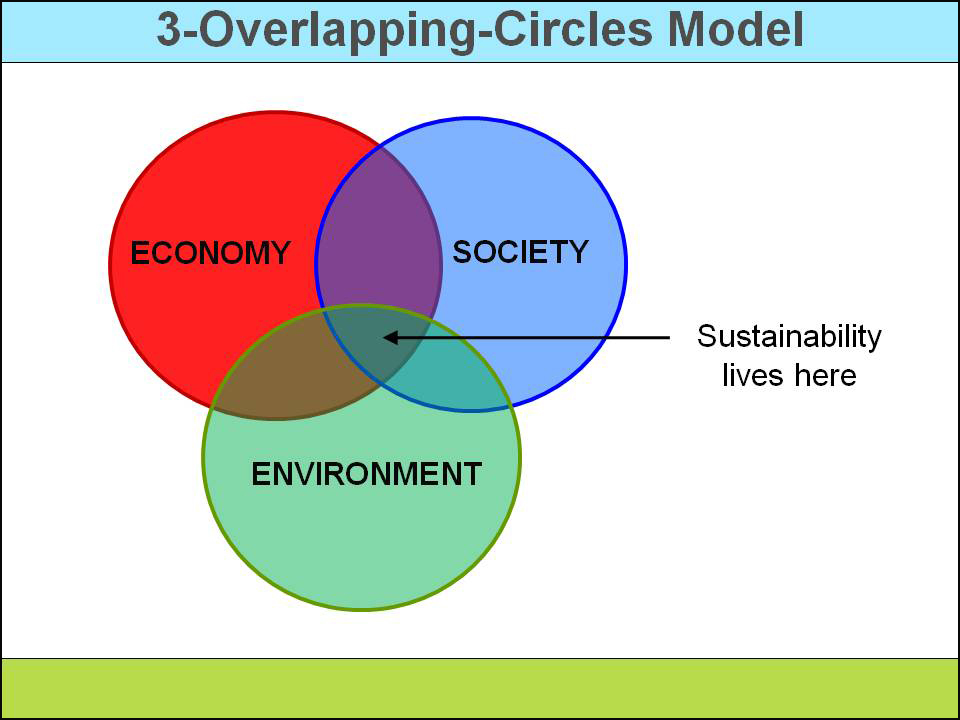
I've found that out of the three diagrams of sustainability, I agree with all, but mainly the 3-overlapping circles. Economy, Society, and Environment work together. They need each other and the visual circle in the middle of all three is the 'perfect' sustainable world. 
I think that a sustainable world is close to impossible. I do not think that we - humans, are able to exist peacefully, have a perfect society, and not harm our environment. Why? Because we do not care enough to keep our world safe. We as humans get upset when we have law-breakers. When we have unethical people making the world disgusting. We forget that we - teachers, families, politicians, etc., that make those people. We enforce punishment, but we don't enforce that the websites, or movies and such be less accessible.
No, I don’t have a thousand different techniques or theories to fix these problems. I personally think that our world is going to get worse. That we are not going to be sustainable. And why do I propose such a preposterous notion?
Because this world is going to end. Many people will say it is a holocaust. I say it is the rapture, followed by the tribulation. It’s not a soft, happy word. Tribulation. A seven-year reign in which the Antichrist sucks as many people into his trap as he can. This world is going to end – and it is our responsibility, as Christians, as the young people of this world, to bring as many people to Christ as we can. To be aware that this world is going to get worse and accept responsibility, because when we become Christians, we are obliged to take up our crosses – DAILY – and follow God.
“Be faithful until death, and I will give you the crown of Life.” Revelation 2:10

                                                                                                            
 (Willard, 2013)
 

3- Nested Dependencies


"If you were to ask a maritime fisherman whether the devastating collapse of the cod fishery off the east coast of Newfoundland was an environmental disaster, a social disaster, or an economic disaster, he would say, “Yes.” The 3-nested-dependencies model reflects this co-dependent reality. It shows that human society is a wholly-owned subsidiary of the environment—that without food, clean water, fresh air, fertile soil, and other natural resources, we’re cooked."  (Willard, 2013)

3-Overlapping-Circles

"The overlapping-circles model of sustainability acknowledges the intersection of economic, environmental, and social factors. Depending on our mindset, we re-size the circles to show that one factor is more dominant than the other two. For example, some business leaders prefer to show the economy as the largest circle because it is the most important to their success and it makes their world go round.
 (Willard, 2013)

"They draw society as the second largest circle because that is where their customers and other important stakeholders live. The environment would then be the smallest because it is the most external to standard business metrics. Unfortunately, this model implies that the economy can exist independently of society and the environment—that the part of the red circle that does not overlap with the blue and green circles has an existence of its own." (Willard, 2013)

 (Willard, 2013)

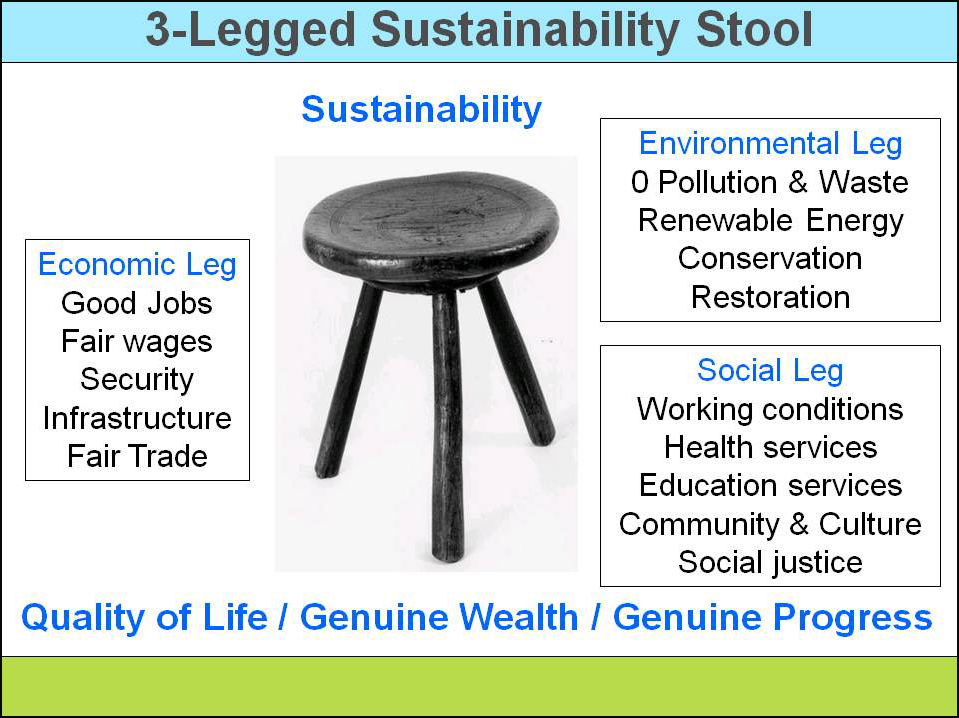
3-Legged Sustainability Stool

"For years, I have used the adjacent slide to illustrate the common three dimensions of sustainability: economic, environmental, and social / cultural. The 3-legged stool metaphor reinforces the three dimensions that are required for us to enjoy a high quality of life— and shows that society is unstable if one of them is weak. The downside of this metaphor is that the economic, environmental, and social legs look separate and equal." (Willard, 2013)


Saturday, 20 April 2013

Australia's relationship with Asia


              Australia's relationship with Asia

Australia's relationship with Asia is quite extensive, quite full of life, and ever growing. 
There are so many exports and imports going on and Asia is so full of life. It is such a busy place. It looks like the day never ends! I don't know much about the relationship with Asia. Except that it is close to Australia as you see in the image below. Asia is made up of many small parts and its population is always expanding. For a while in the past, Australia and parts of Asia definitely did not get along. There is much evidence of that from World War 1 & 2. When I went researching Asia's relationship with us, that is all I could find. I couldn't find anything else. So from my knowledge of what my Uni lecturer taught me and what my Dad's told me, and what little I managed to find on the internet, I can narrow Australia's relationship with Asia to 'It is vast, it is wonderful to see, it is breath-taking the way we have all developed...' I hope that what I found on a few internet resources helps you understand a little better about Australia's relationship with Asia. 


"The emerging alliance between China and Australia is one we must keep our eye on. It is exemplified by Australia’s agreement to sell uranium for power generation to China – an autocratic state still modernizing its nuclear arsenal and maintaining an opaque nuclear position. Australia, as noted a critical U.S. ally, has overlooked concerns that the uranium deal could result in a diversion of more resources for China’s nuclear weapons program. We should be concerned because, for Australia, commercial benefits clearly took precedence over regional security concerns.
"China will acquire 20,000 tons per year of uranium from Australia beginning in 2010. Japan is rather wary of this deal and recognizes the security threat that China poses and the skyrocketing budget of the Chinese military. Beijing has thus far only accepted mostly symbolic nuclear inspections.
"Another issue is that Australian uranium is set for expansive extraction. Uranium export projects in the country have much room to increase. Australia does not even have a nuclear power plant of its own, but controls 40% of known global reserves and only meets about 20% of current global demand. As global demand threatens to outstrip supply, uranium prices soared from 2003 to 2010. Of 18 other commodities, only sugar rose higher. Further, uranium supplies from dismantled Russian nuclear weapons are diminishing, and a number of nations have plans for new nuclear reactors. 

"Australia’s two-way trade with China was $76.2 billion in 2009, up over 15% from a year earlier, and iron ore makes up half the exports. Chinese investment, particularly in minerals and energy, also continues to increase."(Clements, nd) 
                                                                                                                                                                                                 (Grossman, 2013)


References:
Clements, J. (nd). SE Asia/Australia. Retrieved from Jude Clements' Energy Blog: http://www.judeclemente.com/seasia_australia/
 Grossman, P. (2013). Australia-Asia Business Review Blog. Retrieved from Australia-Asia Business Review Blog: http://www.patgrossmann.com/